
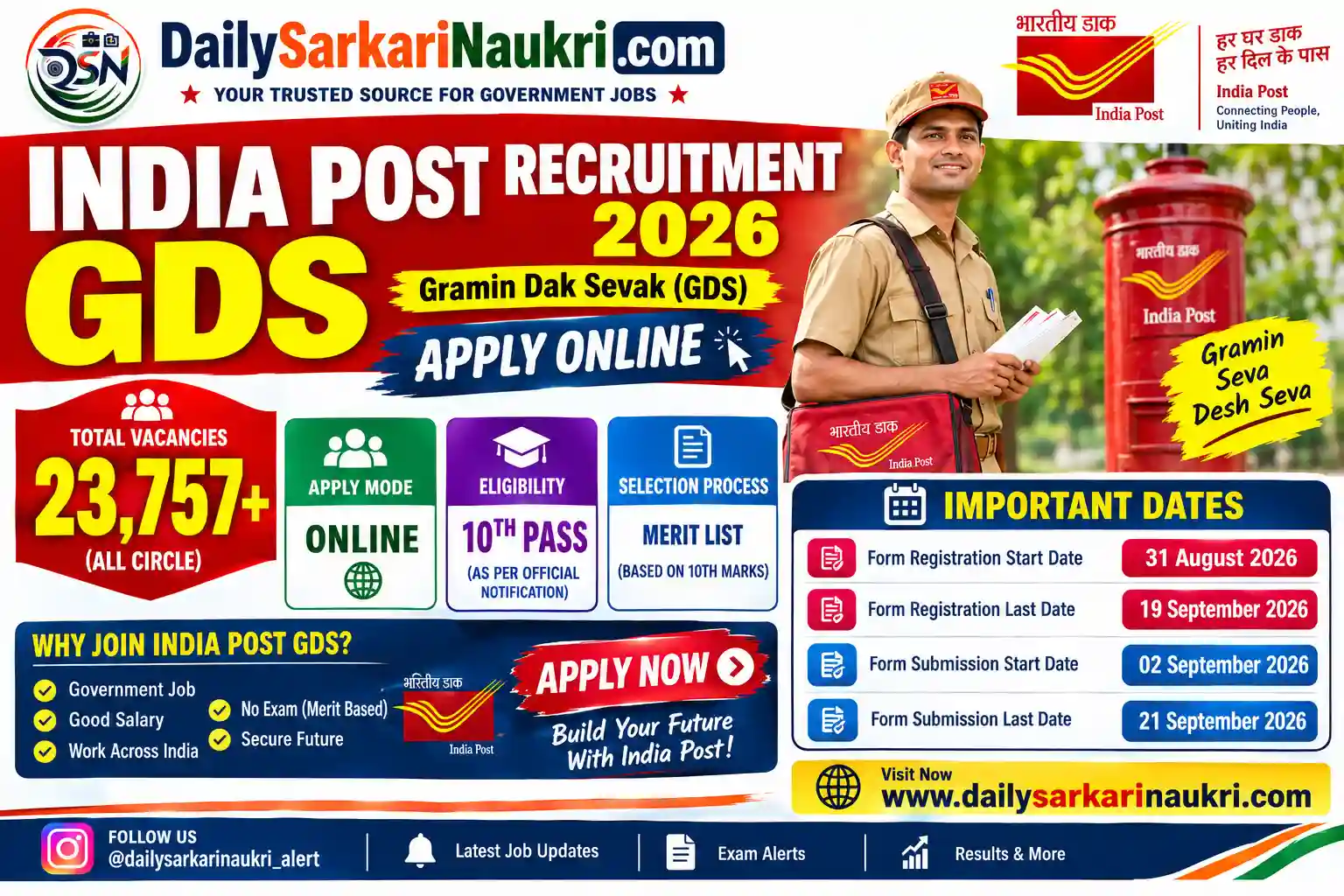
India Post GDS Recruitment 2026: Official Notification Out for Branch Postmaster, ABPM & Dak Sevak (Schedule-II)
If you have passed your Class 10th board exams and are looking for a direct entry into the prestigious Department of Posts without facing any written examination, your biggest window of opportunity is finally open. The Department of Posts, Ministry of Communications, Government of India, has officially released the detailed notification for the Gramin Dak Sevak (GDS) Online Engagement Schedule-II, July-2026 (Notification No. 17-12/2026-GDS).
What makes the India Post GDS recruitment one of the most awaited career announcements in the country is its absolute accessibility. There is no written exam, no preliminary screening, and no viva-voce interview. The selection is determined purely on the basis of an automated, transparent merit list calculated directly from your 10th standard board marks.
Under this recruitment cycle, thousands of vacancies across 23 Postal Circles nationwide are open for three core profiles: Branch Postmaster (BPM), Assistant Branch Postmaster (ABPM), and Dak Sevak.
The online application portal is active for One-Time Registration from 31 August 2026, with final application submissions closing on 21 September 2026 (17:00 Hours).
In this friendly, step-by-step advisory guide, we walk you through every critical requirement of the official notification—including the new 9.5 grade multiplication formula, circle-wise local language mandates, TRCA allowance slabs, and the post-selection accommodation conditions you must know before applying.
📌 India Post GDS 2026: Executive Overview
| Recruiting Organization | Department of Posts, Ministry of Communications (India Post) |
| Notification Reference | No. 17-12/2026-GDS (Schedule-II, July-2026) |
| Posts Announced | Branch Postmaster (BPM), Assistant Branch Postmaster (ABPM), Dak Sevak |
| Job Nature | Holders of Civil Posts outside regular Civil Services (Governed by GDS Rules 2020) |
| Selection Method | 100% System-Generated Merit List (Based on Class 10th Marks) |
| Working Hours | Minimum 4 Hours to Maximum 5 Hours per day |
| Initial Basic TRCA | Rs. 12,000/- (BPM) & Rs. 10,000/- (ABPM/Dak Sevak) |
| Application Mode | Online Only |
| Official Engagement Link | indiapost.gov.in/gdsonlineengagement |
📅 Important Dates & Timeline Schedule
The Department of Posts operates on a time-bound calendar with a strict daily cut-off of 17:00 Hours. Do not wait until the final evening, as rural network servers and payment gateways experience significant delays during the closing days.
| INDIA POST GDS SCHEDULE-II 2026 CALENDAR | |
|---|---|
| Official Notification Date | 20 August 2026 |
| Online One-Time Registration (OTR) Starts | 31 August 2026 |
| Last Date for One-Time Registration | 19 September 2026 (17:00 Hrs) |
| Online Application & Fee Payment Commences | 02 September 2026 |
| Last Date for Online Application & Fee Payment | 21 September 2026 (17:00 Hrs) |
| Application Edit & Correction Window | 23 & 24 September 2026 (17:00 Hrs) |
| Document Verification Period | Within 15 Days of Shortlisting |
| Entire Engagement Process Cut-off Date | 31 December 2026 |
💳 Application Fee & Exemption Rules
The application fee details and exemption rules for GDS Schedule-II recruitment are structured as follows:
| Candidate Category | Fee Payable (Per Chosen Division) | Payment Status |
|---|---|---|
| General (UR), OBC, and EWS Male Applicants | Rs. 100/- | Mandatory Online Payment |
| All Female Candidates | Rs. 0/- | 100% Fee Exempted (NIL) |
| Transwomen Candidates | Rs. 0/- | 100% Fee Exempted (NIL) |
| SC / ST Candidates | Rs. 0/- | 100% Fee Exempted (NIL) |
| Persons with Benchmark Disabilities (PwBD) | Rs. 0/- | 100% Fee Exempted (NIL) |
Payment Mode: Credit/Debit Cards, Net Banking, or UPI via the online gateway. Complete payment within the 10-minute session window before 17:00 Hours on 21 September 2026.
📬 Job Profiles & Service Conditions: Understanding the Roles
Before picking your preferences, you must clearly understand the distinct duties, service conditions, and legal nature of Gramin Dak Sevaks.
1. The Legal Status of GDS
Gramin Dak Sevaks are holders of civil posts, but they are outside the regular civil services of the Union of India. Their employment is governed by the Department of Posts, Gramin Dak Sevaks (Conduct and Engagement) Rules, 2020. Key service conditions include:
- Part-Time Daily Hours: Under Rule 3A, a GDS works a minimum of 4 hours and a maximum of 5 hours a day.
- Mandatory Alternative Livelihood: Candidates must submit an undertaking that they possess an independent source of income besides their postal allowances to maintain their livelihood.
- Service Ceiling: Engagement cannot be retained beyond 65 years of age.
2. Post-Wise Work Breakdown
- Branch Postmaster (BPM): The executive head of the rural Branch Post Office (BO). Responsibilities include managing postal counters, handling India Post Payments Bank (IPPB) financial services, promoting savings schemes, operating Customer Service Centers (CSC), and supervising mail delivery. In single-handed post offices, the BPM carries out mail delivery independently.
- Assistant Branch Postmaster (ABPM): Works under the BPM to handle doorstep delivery of letters and parcels, sale of stamps/stationery, cash management, IPPB deposits and payments, and assisting in counter transactions.
- Dak Sevak: Stationed in Departmental Sub-Post Offices (SO), Head Post Offices (HO), Sorting Hubs, or Railway Mail Service (RMS) transit units. Duties include bag handling, parcel loading/unloading, doorstep mail distribution, and office assistance.
3. Critical Accommodation Rule for BPM Selected Candidates
If you are selected as a Branch Postmaster (BPM), you are legally required to arrange office accommodation for running the Branch Post Office at your own personal expense in the post village before joining. Furthermore, you must mandatorily reside within the operational village where the post office is located.
💰 Salary Structure & TRCA Allowance Breakdown
Gramin Dak Sevaks do not receive standard central pay scales under the 7th CPC; instead, they receive monthly remuneration known as Time Related Continuity Allowance (TRCA):
| Post Category | Minimum Working Hours | Initial Basic TRCA Slab |
|---|---|---|
| Branch Postmaster (BPM) | 4 to 5 Hours Daily | Rs. 12,000/- to Rs. 29,380/- |
| Assistant Branch Postmaster (ABPM) | 4 to 5 Hours Daily | Rs. 10,000/- to Rs. 24,470/- |
| Dak Sevak | 4 to 5 Hours Daily | Rs. 10,000/- to Rs. 24,470/- |
Additional Benefits & Perks:
- Annual Increment: Appointed Sevaks receive a fixed 3% annual increment on their basic TRCA.
- Dearness Allowance (DA): Eligible for central Dearness Allowance on TRCA as declared periodically by the Government of India.
- Social Security Packages: Eligible for GDS Gratuity schemes and coverage under the Service Discharge Benefit Scheme (SDBS), functioning akin to the National Pension System.
- In-Hand Gross Estimate: Adding current DA rates, a new BPM takes home approximately Rs. 18,000 to Rs. 21,000/- per month, while an ABPM or Dak Sevak receives Rs. 15,000 to Rs. 17,500/- per month.
🎓 Detailed Eligibility Criteria: Can You Apply?
Candidates must fulfill all educational, age, and local language parameters on or before the closing date.
1. Educational Qualification
- Class 10th (Matriculation) Pass: Must possess a Secondary School Examination (SSE) passing certificate of the 10th standard from a recognized Board of School Education approved by the Government of India, State Governments, or Union Territories.
- Mandatory Subjects: Candidates must have passed Mathematics and English as compulsory or elective subjects in Class 10th. Equivalent qualifications from unrecognized bodies are strictly rejected.
- Past Academic Records: Candidates with supplementary passes or compartment marks can apply, provided their consolidated marksheet shows a passing status in all compulsory subjects.
2. Mandatory Local Language Requirement
The applicant must have studied the designated local language of the postal circle at least up to the 10th standard level.
(Special Regional Provisions):
- Arunachal Pradesh: Must have studied English or Hindi up to 10th standard AND obtain a tribal dialect certificate issued by the Deputy Commissioner.
- Goa: Must have studied Konkani or Marathi up to Class 10. (If only Marathi was studied, Konkani proficiency must be certified by the Goa Konkani Akademi).
- Sikkim: Must have studied English along with one of the 12 recognized local languages (Nepali, Bhutia, Lepcha, Limbu, etc.).
- Nagaland: Must have studied English or Hindi up to Class 10th and obtain certification in any of the 19 recognized tribal dialects from the district authorities.
3. Age Limit & Relaxations (As on 21 September 2026)
- General (UR) Candidates: Minimum 18 Years, Maximum 40 Years.
Upper Age Relaxations:
- Scheduled Caste / Scheduled Tribe (SC/ST): 5 Years (Up to 45 years)
- Other Backward Classes (OBC-NCL): 3 Years (Up to 43 years)
- Persons with Benchmark Disabilities (PwBD): 10 Years (Up to 50 years)
- PwBD + OBC Candidates: 13 Years
- PwBD + SC/ST Candidates: 15 Years
- Economically Weaker Sections (EWS): No Age Relaxation (10% vertical reservation applies)
4. Auxiliary Skills (Self-Declarations)
- Computer Knowledge: Must possess basic computer operational literacy (smartphones, laptops, and biometric devices).
- Cycling Ability: Must be able to ride a bicycle or operate a two-wheeler for mail distribution.
- Alternative Income: Must have an independent secondary source of livelihood.
📊 How Does the Selection Process Work? (Merit Calculation Rules)
Because there is no written test, understanding how the automated portal calculates your rank is critical.
[Candidate Submits Class 10 Marks & Division Preferences]
                          │
                          ▼
[System Normalizes Grades to Numerical Percentages (Grade × 9.5)]
                          │
                          ▼
[Automated Merit List Generated up to 4 Decimal Accuracy]
                          │
                          ▼
[Shortlisted Candidates Receive SMS/Email Alerts]
                          │
                          ▼
[Physical Document Verification (15 Days) & Pre-Engagement Formalities (30 Days)]
Grade-to-Marks Conversion Table:
If your secondary education board awarded letter grades rather than raw marks, the central system uses a universal 9.5 multiplying factor:
| Grade Awarded | Grade Point (GP) | Multiplier Factor | Reckoned Percentage Score |
|---|---|---|---|
| A1 | 10 | 9.5 | 95.00% |
| A2 | 9 | 9.5 | 85.50% |
| B1 | 8 | 9.5 | 76.00% |
| B2 | 7 | 9.5 | 66.50% |
| C1 | 6 | 9.5 | 57.00% |
| C2 | 5 | 9.5 | 47.50% |
| D | 4 | 9.5 | 38.00% |
Special Cases:
- Dual Marks & Grades: If your marksheet displays both numerical marks and letter grades, you must enter the exact marks obtained. Submitting letter grades when raw marks are present results in immediate application cancellation.
- Tamil Nadu SBSE (2020–2021 Batch): Due to COVID-19 blanket pass policies, students who received general pass certificates without marks are automatically allotted a uniform 66.67% by the system.
- Tie-Breaking Formula: If two candidates share identical marks, the candidate older in age gets priority. If age is also identical, preference follows a strict community hierarchy (ST Trans-woman ➔ ST Female ➔ SC Trans-woman ➔ SC Female, down to UR Male).
💻 How to Apply Online: Step-by-Step Walkthrough
Follow these sequential steps to submit your form without errors:
- Access the Official Portal: Navigate to indiapost.gov.in/gdsonlineengagement.
- Complete One-Time Registration (OTR): Click on "New Candidate Registration". Input your mobile number and email ID, and authenticate both through OTP. Enter your name, father's name, and date of birth exactly as printed on your Class 10th certificate.
- Log in to Application Module: Using your generated unique Registration Number and system password, log into the dashboard.
- Enter Academic Details: Select your board, passing year, and enter your subject-wise marks or grades.
- Select Postal Division & Post Preferences: Choose only ONE postal division. The portal will display all eligible post offices based on your category and local language. Arrange your preference numbers (1, 2, 3...) across as many Post IDs as you desire.
- Upload Standardized Photo & Signature:
- Recent Photograph: 30 KB to 100 KB, JPG/JPEG format, 4:5 aspect ratio (320 × 400 pixels), light/white background. Face must occupy 70–80% of the image.
- Signature: 20 KB to 100 KB, JPG/JPEG format, 5:2 aspect ratio (300 × 120 pixels) on white paper using blue or black ink.
- Verify via Preview & Settle Fee: Review every entered field. Settle the Rs. 100 fee online (if applicable) and download the final submitted application receipt.
🚨 5 Critical Application Traps to Avoid
- The Single Division Boundary: An applicant can apply for multiple posts, but strictly within ONE selected postal division. Applying across multiple divisions using duplicate registrations results in permanent disqualification across all circles.
- Name Mismatches with Matriculation Certificate: Even a single letter variance between your online form and your original Class 10 marksheet leads to automatic rejection during document verification.
- DigiLocker / API Setu Mismatch: India Post cross-verifies secondary school marksheets directly via API Setu and DigiLocker databases. Ensure your online board records match your physical certificate perfectly.
- Ignoring the 15-Day DV Window: Shortlisted candidates receive alerts via SMS and email. You must report to your designated Divisional Superintendent within 15 days of the result declaration, or the system marks you as "Non-Turned Up" and passes the post to the next applicant.
- Uploading Blurred Signatures: Applications with miniature, blurry, cropped, or pixelated signatures are automatically flagged by portal image validators and rejected.
🎯 Important Direct Links
❓ Google's Most Searched FAQs: India Post GDS 2026
Ans: No! You do not need to upload or possess a separate private computer training certificate at the time of online application. You only need to submit a basic undertaking declaring that you are computer literate and capable of operating a smartphone/handheld terminal from day one.
Ans: Because selection is 100% merit-based without an entrance exam, cut-offs are typically high. In popular divisions across Uttar Pradesh, Bihar, Rajasthan, and Madhya Pradesh, unreserved category cut-offs frequently range between 90% to 98%, while reserved categories generally hover between 82% to 92%.
Ans: No. Candidates are strictly restricted to selecting only one postal division. However, within that chosen division, you can exercise preferences for as many individual post offices and Post IDs as you qualify for.
Ans: Absolutely not. There is no interview, no physical running test, and no typing assessment. Selection is finalized exclusively through academic merit in Class 10th followed by physical document verification.
Ans: No. The accommodation rule applies exclusively to Branch Postmasters (BPM), who must provide rented or owned space within the post village to house the Branch Post Office. ABPMs and Dak Sevaks only need to reside within the delivery limits of their assigned postal beat.
🏁 Final Words & Practical Next Steps: The India Post GDS Schedule-II 2026 recruitment is one of the most accessible pathways to entering public service, particularly for rural candidates and fresh matriculate pass-outs. Double-check your Class 10 marksheet details, select your division preferences strategically where local competition aligns with your score, and finalize your registration before the 21 September 2026 deadline.
Official Disclaimer: This informational guide is compiled strictly on the basis of the official Notification No. 17-12/2026-GDS issued by the Department of Posts, Ministry of Communications, Government of India. Candidates must thoroughly read the complete notification and verify circle-wise local language tables on indiapost.gov.in/gdsonlineengagement before submitting their form.